
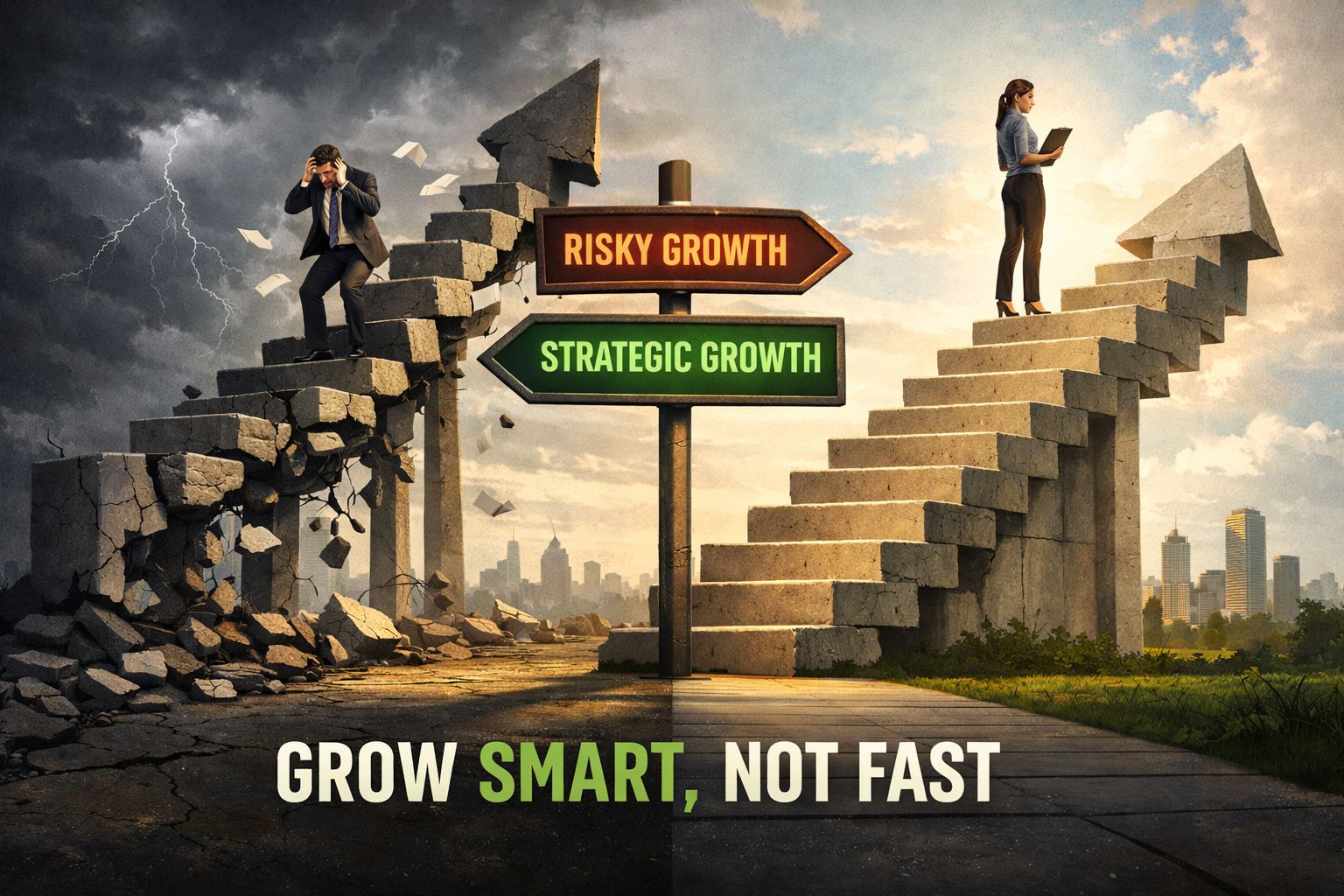
In small business, growth is treated like the ultimate goal.
More revenue.
More customers.
More locations.
More hires.
If things are moving, the instinct is to push harder.
But here’s a truth most business owners learn the hard way:
Growth isn’t automatically progress.
Sometimes it’s risk wearing a nice outfit.
The Pressure to Grow Is Constant
Growth is praised everywhere:
-
Investors expect it
-
Peers celebrate it
-
Social media glamorizes it
Staying the same size can feel like failure, even when the business is profitable, stable, and well-run.
That pressure leads owners to ask the wrong question:
“How do we grow faster?”
When the better question is often:
“Are we actually ready to grow at all?”
Growth Magnifies Everything — Including Weaknesses
Expansion doesn’t fix problems. It amplifies them.
Thin margins get thinner.
Cash flow gaps get wider.
Operational cracks become structural issues.
What feels manageable at one scale can become dangerous at the next.
Before growing, it’s worth asking:
-
Are our margins strong enough to absorb mistakes?
-
Is cash flow predictable — or just “usually okay”?
-
Do systems work without constant oversight?
-
Can leadership handle complexity, not just volume?
If the answer to those questions isn’t clear, growth adds stress, not value.
Why “Opportunity” Can Be a Trap
Many growth decisions are framed as opportunities:
-
A new large client
-
A second location
-
A new product line
-
A sudden spike in demand
Opportunities feel rare and urgent which makes them hard to say no to.
But not every opportunity is aligned with your business’s current capacity.
Saying yes too quickly can lock you into:
-
Higher fixed costs
-
Longer cash cycles
-
Operational commitments you can’t unwind easily
Sometimes the smartest move is passing even when the opportunity looks good on paper.
The Difference Between Strategic Growth and Emotional Growth
Not all growth decisions come from strategy.
Some come from:
-
Fear of missing out
-
Comparison to competitors
-
Ego or external validation
-
A need to “prove” the business is successful
That kind of growth is emotional and emotional growth decisions are expensive.
Strategic growth, on the other hand, is slower, quieter, and more intentional.
It’s based on:
-
Clear financial data
-
Timing, not urgency
-
Risk tolerance
-
Long-term sustainability
It doesn’t look impressive right away but it holds up over time.
Stability Is a Competitive Advantage
In uncertain environments, stability is power.
Businesses that:
-
Control cash flow
-
Maintain healthy reserves
-
Avoid unnecessary fixed costs
-
Grow only when conditions are right
have more options than businesses that are constantly stretched.
Stability gives you leverage:
-
To negotiate better terms
-
To weather downturns
-
To invest when others can’t
Growth is optional. Survival and flexibility are not.
Questions Worth Asking Before Your Next Expansion
Before you grow in any direction ask yourself:
-
If revenue dipped 15%, would this still work?
-
Does this increase or reduce financial risk?
-
Are we growing because it’s strategic — or because it feels expected?
-
What problem are we trying to solve with growth?
If growth is the answer, the question might be wrong.
Final Thoughts
The strongest businesses aren’t the ones that grow the fastest.
They’re the ones that grow on purpose.
Knowing when to push forward matters but knowing when to hold steady is just as important. In many cases, restraint isn’t a lack of ambition.
It’s a sign of discipline.
And discipline is what keeps businesses alive long enough to grow again when the timing is right.
DISCLAIMER: This content is for informational purposes only. Gate Rock Capital and its affiliates do not provide financial, legal, tax or accounting advice.